Table of Contents▾
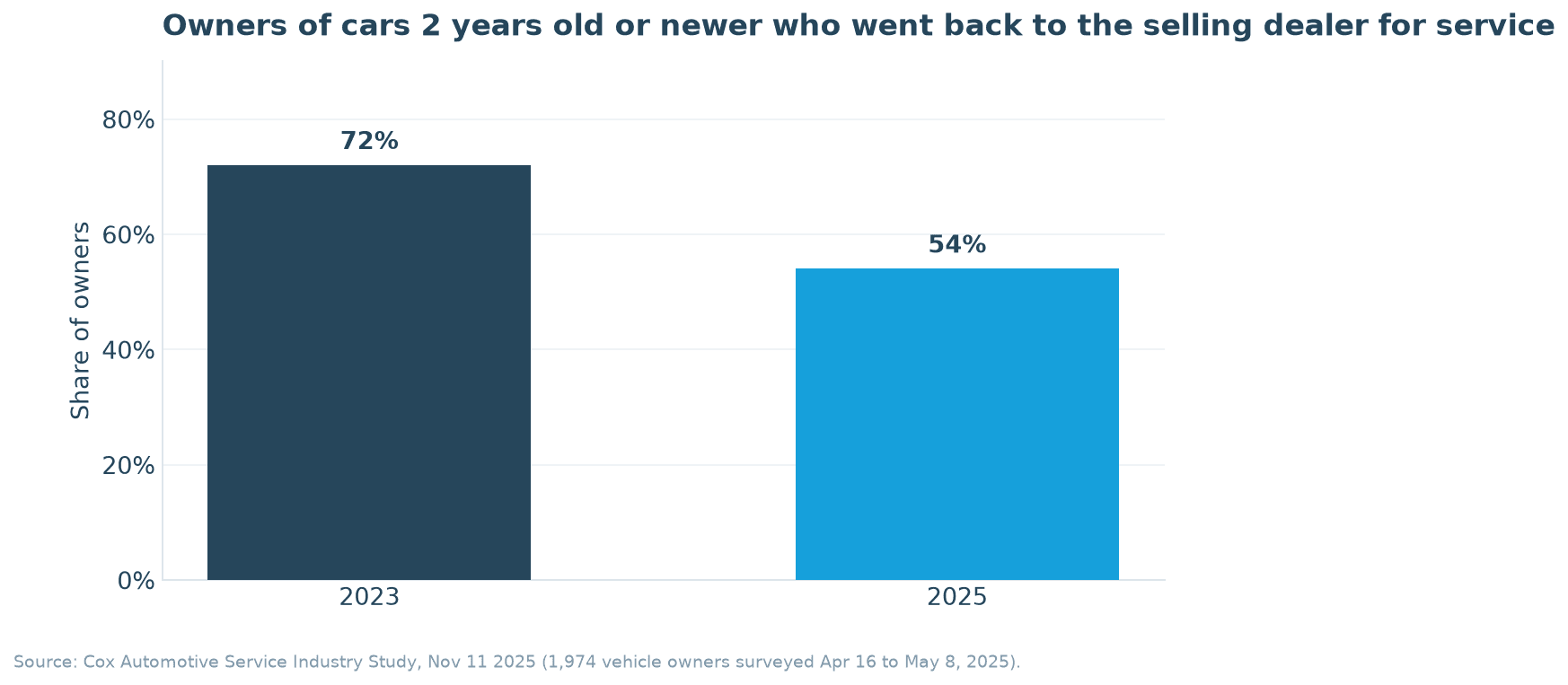
Short answer: automotive customer retention is the share of past buyers who come back for service, their next car, or a referral. It is falling: Cox Automotive found 54% of owners of cars two years old or newer returned to the selling dealer for service in 2025, down from 72%.
Most independent dealers spend nearly all of their marketing money on the first sale. The customer signs, drives off, and the record sits in a spreadsheet or an old deal jacket until they show up again by luck. That is the retention gap. The 2025 data shows it widening on the service side, where franchise stores have the most to lose, and it was never strong on the sales side for independents.
This guide covers what retention means for a used-car dealer, what the latest Cox Automotive research says, a touchpoint calendar you can run from a CRM, and how software re-engages past buyers without adding headcount. Every figure is cited to its source.
Automotive Customer Retention, Explained
Automotive customer retention is the percentage of customers who buy from you, then keep doing business with you. It has two sides. Service-side retention is the share of owners who bring the car back to the selling dealer for maintenance and repair. That is what most industry studies measure, because franchise dealers earn much of their gross in the service lane. Sales-side retention is the share of past buyers who purchase their next vehicle from you, plus the people they refer. For an independent used-car dealer with no service department, sales-side retention is the only kind that matters.
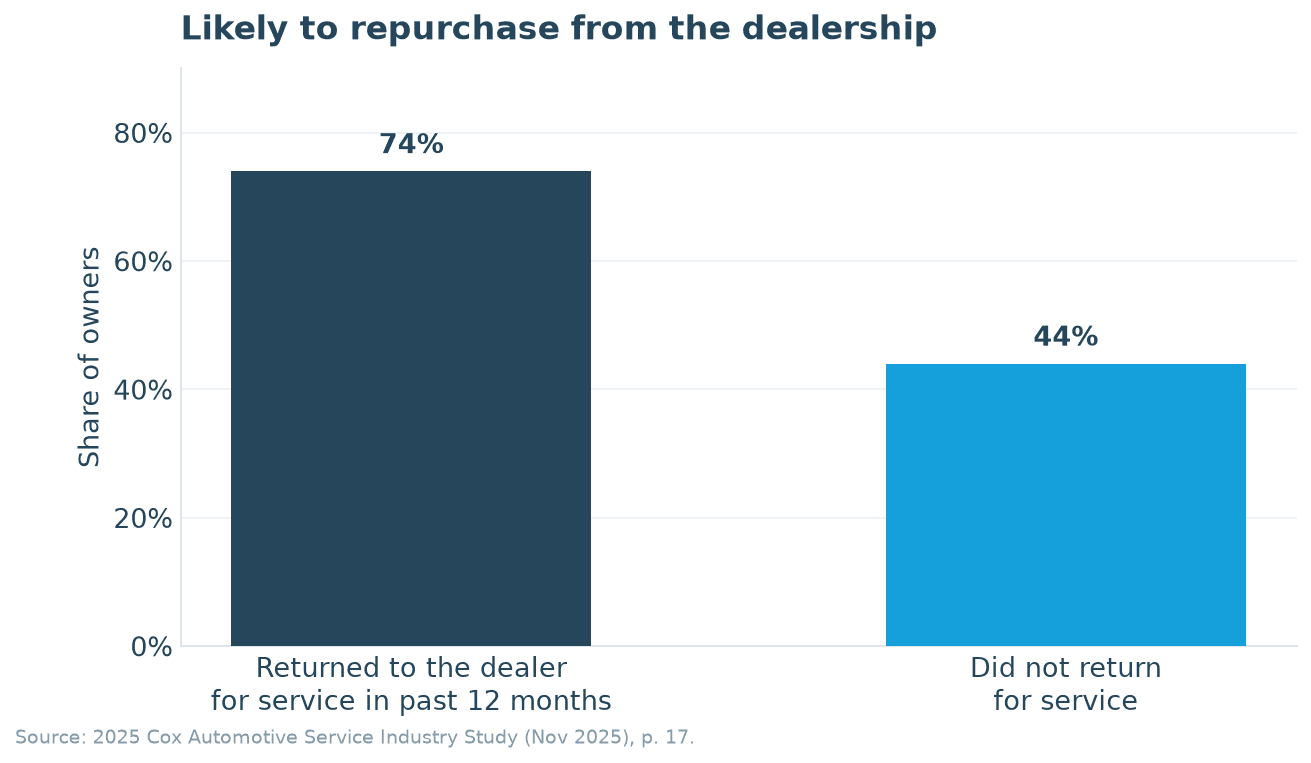
The two are linked. In the Cox Automotive Service Industry Study, owners who returned to the dealer for service in the past 12 months were far more likely to say they would buy there again (74%) than owners who did not (44%). Service contact keeps the relationship warm. An independent has to replace it with a planned sequence of texts, emails, and calls between purchases.
Independents lose the second purchase for a simple reason. Nobody owns it. The salesperson who sold the car may have left. The customer's number lives in a DMS deal screen nobody opens after funding. Three years later the buyer needs a car, searches online, and picks whichever store answers first. Retention is not a loyalty program. It is a follow-up schedule with a name next to every step.
What the 2025 Cox Automotive data says
The most current retention research comes from the Cox Automotive Service Industry Study, published November 11, 2025. It surveyed 1,974 vehicle owners aged 18 to 75 who had serviced a car in the previous 12 months, with fieldwork between April 16 and May 8, 2025. These are service-side figures, and they skew toward franchise stores with service departments, so read them as a signal about customer behavior rather than a benchmark for a used-car lot.
- Dealerships handle 12% fewer service visits than they did in 2018, even as the number of vehicles on the road grew. The dealer share of all service visits fell from 33% in 2018 to 29% in 2025, according to the study deck.
- Only 54% of owners with cars two years old or newer went back to the dealership where they purchased for service, down from 72% in 2023.
- Nearly half (45%) are dissatisfied with their dealership service experience, primarily because of unexpected costs and poor communication.
- Owners who service at the dealership are more likely (74%) to buy their next car from the same place. Among owners who did not return for service, that figure is 44%. The study also reports that 88% say the service experience impacts their likelihood to return to the dealer for a purchase.
- Over half of owners who need a big repair might trade in their car instead.
Why are owners leaving? The study deck lists the top reasons for not returning to the dealership of purchase: the location is not convenient, and the belief that the dealer will overcharge. Among owners who had a frustration, the biggest complaints were that service took longer than expected (24%), finding out how much they charge (13%), being pushed additional services (13%), and a final price higher than the estimate (12%). Each of those is a communication failure before it is a pricing failure. The owner did not know what would happen, how long it would take, or what it would cost.
The flip side matters for any dealer. Cox notes that customers with a better-than-expected experience cited speed and communication. Cox's separate 2025 Car Buyer Journey Study (2,344 recent buyers, fielded August 6 to September 5, 2025) describes highly satisfied buyers as more dealer loyal and more often contacted by a dealership with a good deal. Buyers who hear from the store after the sale come back.
Retention touchpoints by timing
A retention program is a calendar. Each row is a moment when a past buyer is open to hearing from you, the channel that fits, who owns it, and the CRM trigger that fires the message without anyone remembering to. Ava is Get My Auto's AI BDC. She works by text, email, and chat, not by phone, so anything marked "call" stays with a person.
| Timing | Touchpoint | Channel | Owner | CRM trigger |
|---|---|---|---|---|
| Delivery day | Thank-you and a direct line for questions | Text | Salesperson | Deal marked sold |
| 3 to 7 days | Check-in: how is the car, any issues, review request | Text, then call if no reply | Salesperson or Ava | Sold date plus a few days |
| 30 days | First-payment reminder, referral ask, title and plate status | Text or email | Ava or BDC | Sold date plus 30 |
| Service intervals | Maintenance reminder, with a partner shop if you have no service drive | Text or email | Ava | Mileage or months since purchase |
| 12 months | Anniversary note, market-value update on their vehicle | Email, then text | Ava | Sold date plus 12 months |
| Lease or loan end | Payoff options, upgrade offer, trade appraisal | Text, then call | Ava, then salesperson | Term end date minus months you choose |
| Trade-in equity | Equity alert: what their car is worth versus payoff | Text | Ava, then salesperson | Payoff below estimated value |
| Inventory match | New arrival that fits what they asked about before | Text | Ava | Vehicle added matching saved preferences |
Two rules make this work. Every touch must carry something useful: a status, a value, a reminder, or an answer. And every touch must be logged on the customer record so the next person to pick up the phone knows what was already said.
Dealership aftersales communication without a service drive
Franchise stores run aftersales communication from the service lane: appointment reminders, repair-order updates, recall notices. Most independent dealers have none of that, which is exactly why they need a plan. For an independent, aftersales communication is the set of messages that keep the store in the customer's phone between the day they buy and the day they need another car.
The Cox findings say what those messages should do. Owners left dealers over unexpected costs and poor communication, so the sequence should be about clarity: title and registration status, when the first payment is due and to whom, what the service contract covers, and where to go for maintenance. The dealer that answers those questions before the customer asks is the one they call first next time.
- Week one: confirm the paperwork is done and the plates or title are on the way. This one text prevents most first-month complaints.
- Month one: confirm the lender, the payment date, and the amount. Buyers who miss a first payment blame the store.
- Every service interval: a maintenance reminder. With no service drive, name a partner shop and ask for a copy of the invoice so the mileage lands on the CRM record.
- Any time a matching car arrives: a photo and a link. Past buyers who told you what they wanted are the warmest leads on the lot.
- Twelve months and beyond: a value update. What their car is worth today is the opening line of the next deal.
- Referral asks: once at 30 days and once at 12 months, with a real thank-you when it works.
Automotive customer retention software: what a CRM automates
Automotive customer retention software is not a separate product. It is a CRM with three things: a complete customer record, timed automation that fires messages off that record, and an AI layer that holds the conversation when a customer replies.
| Retention task | Manual, on a spreadsheet | Automated in a dealer CRM |
|---|---|---|
| Customer record | Phone number in the deal jacket, notes in someone's head | Purchase history, communication history, trade-in info, and family members on one record |
| Follow-up after delivery | Happens if the salesperson remembers | Scheduled text fires from the sold date, every time |
| Service and payment reminders | Rarely sent | Automatic reminders triggered by date or mileage |
| Re-engaging past buyers | Someone pulls a list once a year, if ever | Aged records worked continuously by text and email |
| Reply handling | Reply lands on a personal cell, may be missed | Reply logged to the record and answered, including after hours |
| Handoff to a salesperson | Verbal, often lost | Appointment set and assigned with the full thread attached |
| Accountability | None | Every interaction logged; managers see who is working which customers |
The re-engagement row answers the most common question: is there software that automatically re-engages a dealership's past car buyers? Yes. An AI BDC does it. It takes the customers and leads that went quiet, sends a relevant message, holds the conversation when they reply, and books the appointment, on records months or years old that no salesperson will get to by hand. Our guide to what an AI BDC does for a car dealership walks through the mechanics.
- 1Get every past buyer into the CRM with a phone number, email, vehicle, and sold date. If the deals live only in the DMS, import them.
- 2Build the touchpoint calendar above as automation rules: sold date plus 3, plus 30, plus 12 months, plus term end. Start with texts; add email for the value update.
- 3Turn on AI re-engagement for records with no recent activity and let it run every day.
- 4Route replies and appointments to a named salesperson with the thread attached, so nobody asks the customer to repeat themselves.
- 5Review one report weekly: past-buyer conversations started, appointments set, and cars sold to previous customers. That is your retention rate.
How Get My Auto fits
Get My Auto is a CRM built for independent dealers, with Ava, an AI BDC, included. Retention runs on the pieces described on the CRM for auto dealers page. Contact Management keeps purchase history, communication history, preferences, family members, and trade-in info on one record, and flags when customers are due for their next vehicle. Text Messaging Built Right In logs every text and schedules automated texts and appointment reminders. Task & Appointment Management creates follow-up tasks and escalates them when overdue. Marketing Automation covers email sequences and automatic service reminders, and Text Blast Campaigns message past customers by vehicle type or price range when the right car lands.
Ava does the part no team keeps up with by hand. On the AI for auto dealers page the capability is listed as Re-engages cold and aged leads: Ava works old and unworked records for as long as it takes, by text, email, and chat, day or night. She also follows up on the day you promised, so a "call me in the spring" note becomes a message in the spring. Ava does not make phone calls today. When a customer calls in, she receives the call or voicemail transcript so her next message knows what was said. Voice AI is on the roadmap.
The CRM and Ava together are $695 a month with a 60-day free trial, texting included, and no per-deal platform fees. For the wider comparison, read our best CRM for car dealerships guide or the case for why car dealers need an automotive CRM. Or start the 60-day free trial, import your sold customers, switch on the touchpoint schedule, and watch what comes back.
Frequently asked questions
Topics
Share this article
Help others discover this content