
Table of Contents▾
The short answer: pick the car dealer website provider that shows receipts. Ask for live customer sites you can speed-test yourself, proof of where a lead goes after the form, named case studies with real numbers, and a contract you can leave. Marketing claims are free. Verifiable proof is what separates providers.
If you run an independent dealership, your website is not a brochure. It is the storefront most of your buyers walk into first, and for many of them it is the only one. Franchise stores often have a website provider handed to them by the OEM program. You do not. That freedom is an advantage, and it is also how independents end up stuck on a slow template site with a three-year contract.
We sell dealer websites ourselves, so read this with that in mind. But everything below is the same test we would tell you to run on us. Nearly every provider in this industry says "fast," "seamless," and "trusted by thousands." The way to choose between them is to ignore the adjectives and demand the evidence.
Why the provider choice hits independents harder
A franchise store has co-op money, an OEM feed, and a corporate site standard. An independent has none of that cushion. Your website provider decides how fast your inventory loads on a phone, whether Google can read your vehicle pages, where your leads land at 9 pm, and what happens to your domain if you ever leave. Each of those is margin.
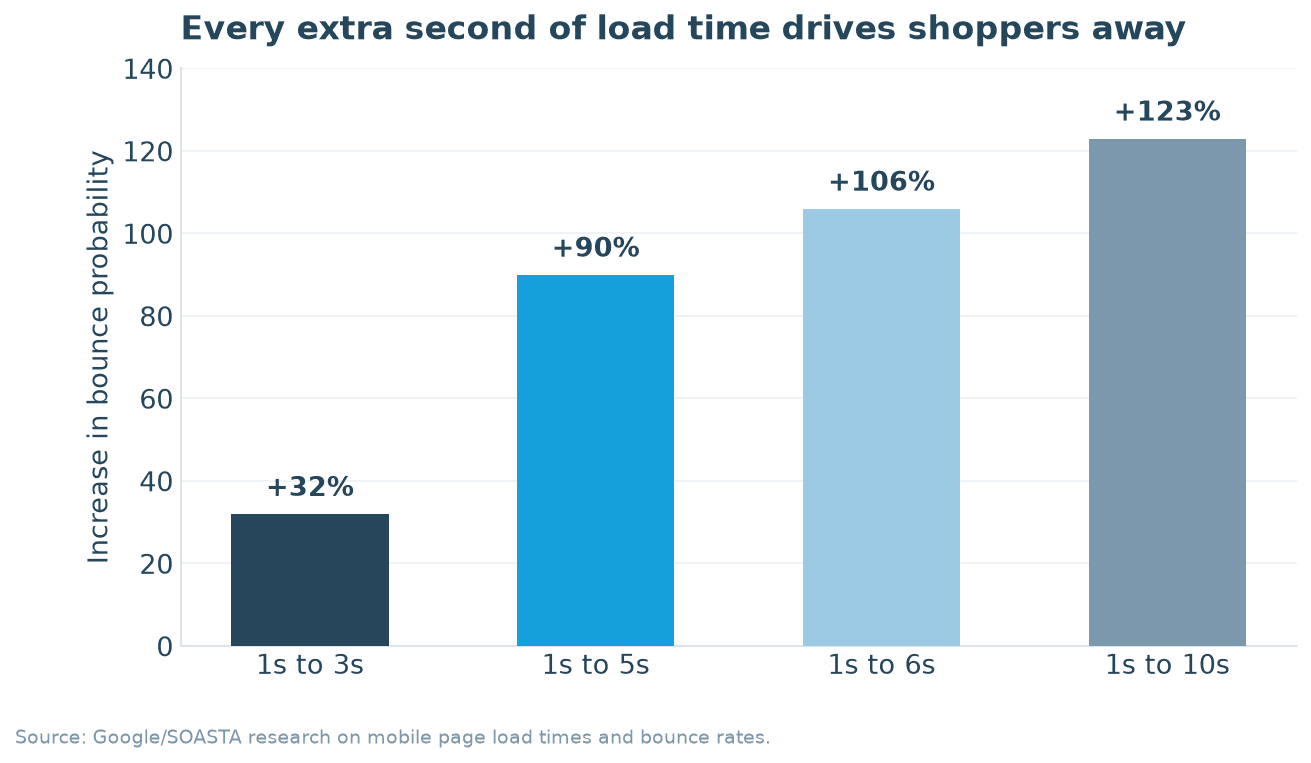
Speed alone is worth real money. Google's own research with SOASTA found that the probability of a shopper bouncing rises 32 percent when a mobile page slows from one second to three, and it roughly doubles by five seconds. Plenty of dealer sites sit on the wrong side of that curve.
The six checks that actually separate website providers
1. Verifiable speed, not a speed claim
Just about every provider says fast. Very few publish scores. On the demo, ask them to open Google PageSpeed Insights and test one of their live customer sites on mobile, while you watch. A platform that is actually fast will do it without flinching. If what you get back is a brochure line about lightning speed, you have your answer.
2. A portfolio of live sites, not template screenshots
A styles gallery tells you what a designer mocked up once. A list of URLs tells you what real dealers run today. Ask for three live customer sites from stores like yours, independent, similar inventory count. Then browse them on your phone like a buyer would: search the inventory, open a vehicle page, tap the phone number.
3. Where the lead goes after the form
This is the one most dealers skip, and it is the most expensive to get wrong. A website that generates a lead and then emails it into an inbox has done half the job. What answers that lead at 9 pm on a Sunday? How fast? Who follows up on Tuesday when the buyer goes quiet? If the provider only builds websites, the honest answer is: whatever CRM you bought from someone else, if the integration holds up. Platforms where the website, CRM, and follow-up are one system do not have that seam.
4. Named proof, with numbers
Testimonials with no name attached are decoration. Ask for a case study with a dealership name, a person, and numbers you could verify with a phone call. As a benchmark for what real proof looks like, this is how Twins Auto Sales booked 164 test drives with the lead work automated: named store, named GM, real counts.
5. Inventory and data that stay yours
Your inventory should flow in from your DMS automatically, sold units should come down on their own, and your listings should syndicate out to the marketplaces you pay for. Just as important: the domain, the content, and every lead record belong to you. Ask the question directly, because the answer is in the contract, not the sales deck.
6. A contract you can leave
Long lock-ins exist to protect providers from their own churn. Month-to-month exists when a provider expects to earn the renewal. Read the term, the cancellation clause, and what it costs to take your domain and content with you. A provider confident in the product does not need three years of insurance.
The claim versus the receipt
Here is the cheat sheet. The left column is what every provider's website says. The right column is what you ask for instead.
| The claim on their site | The receipt to demand |
|---|---|
| "Industry's fastest websites" | Live PageSpeed Insights scores on three current customer sites, tested while you watch |
| "Browse our portfolio" | URLs of real dealer sites running today, not template screenshots |
| "Seamless CRM integration" | A walkthrough of where a lead lands after submit, and what answers it after hours |
| "Trusted by thousands of dealers" | Two named customers you can call |
| "SEO built in" | Vehicle pages that are indexable, schema markup you can view in the source, and a real store's search results |
| "Award-winning support" | The contract: term length, cancellation cost, and who keeps the domain and content |
Six questions to ask on the demo
- 1Run one of your live customer sites through PageSpeed Insights right now. What does it score on mobile?
- 2A lead comes in from my site at 9 pm on a Sunday. Walk me through the next five minutes.
- 3Who owns my domain, my content, and my lead data if I leave?
- 4What is the contract term, and what does it cost to cancel early?
- 5Show me a customer like me: independent, similar inventory. What results did they get, with numbers?
- 6Does inventory sync from my DMS automatically, and how fast do sold units come off the site?
Red flags worth walking away from
- A portfolio page with no links to live sites
- Speed claims with no numbers attached. "Lightning fast" is not a score
- Testimonials that are images with no person named
- A lead form that sends an email notification and calls that CRM integration
- A long contract where you do not keep the domain
- A "top website providers" article published by a provider that ranked itself first
How Get My Auto answers these same questions
Fair is fair. Run us through the same test. Our dealer websites score at the top of PageSpeed Insights, and the product page shows a live example with its real load time, not a claim. A lead from your site does not get emailed into a void: it lands in our dealer CRM and Ava, our AI assistant, answers it in seconds, day or night, then books the test drive. The named proof is public, with the store and the GM on the record. And there are no long-term contracts, because the product is supposed to earn the renewal.
Frequently asked questions
Topics
Share this article
Help others discover this content
Continue Reading
View All
Best CRM for Car Dealerships (2026 Buyer's Guide)
164 Test Drives, No New Hires: The Independent Dealer's Edge
Marketing Strategy for Independent Used Car Dealers

FTC Price Transparency FAQs: What Car Dealers Must Do (2026)