Table of Contents▾
Independent and used car dealers are operating in the most challenging buyer environment of the last decade. Used vehicle prices climbed again in March 2026, with average segment prices up roughly 1.7% month over month according to Carfax. New car affordability has pushed average transaction prices to $49,275, and that pressure is funneling more buyers into the used market while squeezing margins for the dealers serving them. At the same time, buyer behavior has changed structurally. According to research from Ekho, 30% of vehicle shoppers in 2026 are now using generative AI tools to research their next car, with ChatGPT alone capturing 68.4% of that activity. Older signals like print, broadcast, and even some traditional third-party listing sites are losing influence. The buyer is on a phone, in a chat window, and asking an AI for the best dealer near them.
This is the marketing playbook I would build if I walked into an independent or used car dealership tomorrow as the CMO. It is grounded in what is actually working in 2026, not last year's tactics dressed up in new jargon. SEO and AI search visibility sit at the core because that is where the modern car buying journey starts. Around that core, you need disciplined paid media, smart social and retargeting, fast lead handling, retention marketing, and reputation management. None of it works in isolation, and none of it works without a platform that connects the website, inventory, CRM, and AI in one operational stack.
Start With the Modern Buyer, Not the Old Playbook
Before any tactic, get honest about who you are marketing to. The shopper coming to your lot today researched online before they ever called. McKinsey and Cox Automotive data show that 95 to 97% of car buyers research online before stepping foot on a dealership. That research is no longer linear. A typical used car buyer touches a search engine, an AI assistant, a marketplace listing, social retargeting, and a Google Business Profile review snippet, often in the same afternoon, often on a phone.
Three behavioral shifts matter most in 2026. First, AI search has become a real channel, not a novelty. Industry analysis from Exposure Ninja and Averi shows AI search traffic converts at roughly 14.2% compared to 2.8% for traditional Google organic. That is a 5x conversion advantage for the dealers who show up there. Second, mobile is the dominant device for automotive research, with over 70% of automotive shoppers using a mobile phone during the buying journey according to Demand Local. Third, speed to lead has become an existential metric. Harvard Business Review research shows responding within 5 minutes makes a dealer 21 times more likely to qualify the lead than responding at 30 minutes. The DAS Technology 2025 Lead Response Study found that 19% of dealers still take over an hour to respond, and 4% never respond at all. That gap is where independent dealers can win.
Your strategy has to be built around these three realities. Everything that follows is designed to make sure you are visible where modern buyers look, fast where modern buyers expect you to be fast, and trustworthy enough that they choose you when the comparison happens.
The Core: Modern SEO, AEO, and GEO for Car Dealers
SEO is not dead. It has split. Traditional Google rankings still drive the majority of commercial intent traffic, but Answer Engine Optimization (AEO) and Generative Engine Optimization (GEO) now determine whether you show up inside Google AI Overviews, ChatGPT Search, Perplexity, and Gemini. According to Similarweb 2026 data, ChatGPT Search alone now processes 250 to 500 million weekly queries. Google AI Mode is producing zero-click rates as high as 93%. If your dealership only ranks the old way, you are losing visibility on the queries where intent is highest.
Technical Foundations That Actually Move Rankings
Most dealer websites fail before content ever gets read. Google has been mobile-first indexing for years, and 65% or more of dealership traffic is mobile. Sites that take more than two seconds to render lose ranking signals and lose buyers in the same breath. The technical baseline for a competitive dealer site in 2026 is non-negotiable. Sub-second load times on mobile. Core Web Vitals passing across LCP, INP, and CLS. Schema markup deployed at the page type level, not just sitewide. Specifically, every Vehicle Detail Page should carry Vehicle schema, Product schema, Offer schema with price and availability, and AggregateRating schema where reviews exist. Your dealership homepage and contact pages need LocalBusiness and Organization schema. Your service pages need Service schema. Without this, AI assistants and Google rich results have nothing structured to read.
This is exactly why the platform layer matters. Trying to retrofit schema, speed, and AI readiness onto an outdated dealer website is more expensive than replacing it. Get My Auto built its AI-powered dealer website platform on Next.js with sub-second load times, schema baked in at the template level, GEO optimization for AI search, and DMS integration that keeps inventory current. That is the foundation. Without it, the rest of this strategy is harder than it has to be.
Local SEO Is Still the Single Highest-ROI Channel for Independents
For an independent or used car dealer, the most valuable buyer is within a 10 to 25 mile radius. Demand Local research indicates 71% of automotive sales happen within 10 miles of the dealership, and "near me" searches in automotive have grown over 200% in recent years. Local SEO is not a side project. It is the engine.
Your Google Business Profile is the single most important asset you do not pay for. Treat it like a storefront. The 2026 essentials for a dealer GBP look like this:
- Primary category set as "Used Car Dealer" with relevant secondary categories like "Auto Loan Provider," "Car Finance and Loan Company," and "Auto Repair Shop" if you offer service.
- Complete NAP (name, address, phone) consistent across your website, GBP, Cars.com, CarGurus, Yelp, BBB, and every directory you live on. Inconsistent citations actively hurt you.
- Vehicle inventory feed enabled through Google. This is what surfaces vehicle cards in Maps and the knowledge panel.
- Weekly Google Posts featuring new arrivals, financing offers, and trade-in promotions.
- Photos refreshed monthly. Showroom, sales team, delivery moments, and detailed lot shots. Generic stock photos are a missed signal.
- A defined review acquisition process. Used dealers who systematically request reviews after every sale outrank competitors who collect them passively.
Local SEO also extends beyond GBP. Build dedicated city and service-area pages for every meaningful market within your reach. A dealer in Riverside should have unique pages targeting San Bernardino, Corona, Moreno Valley, and Ontario. Each page needs unique content, localized references, embedded inventory relevant to that market, and review schema. Doorway pages get penalized. Genuinely localized pages do not.
Inventory Pages: The Hidden SEO Goldmine Most Dealers Waste
Vehicle Detail Pages (VDPs) are the highest-volume page type on a dealer website and the worst-optimized in the industry. Most carry generic VIN-decoded descriptions, stock photos pulled from manufacturer assets, no schema, and no unique on-page content. AI search engines treat that as thin content and skip you. Buyers treat it as low-effort and bounce.
In 2026, every VDP needs three things. First, a unique, AI-generated description that highlights packages, options, and condition specifics buyers actually search for. Second, full Vehicle and Product schema with offer pricing, availability, mileage, and condition. Third, structured trust signals on the page itself: reviews, financing terms, trade-in CTA, and local context like "available for test drive at our [city] location." The dealers who treat VDPs as landing pages, not catalog entries, see materially higher organic traffic and conversion rates. Get My Auto's website platform handles AI-generated descriptions and schema automatically across the inventory feed, which is the only practical way to do this at scale when you are turning 50 to 200 vehicles a month.
AEO and GEO: Showing Up Where AI Recommends Dealers
Answer Engine Optimization and Generative Engine Optimization are the new layer on top of traditional SEO. The premise is simple. When a buyer asks ChatGPT "What is the best used car dealership near Tampa?" or types into Google AI Mode "reliable used SUVs under $20k in Phoenix," you want your dealership cited in the answer. AI assistants pull from structured content, fresh sources, and brand mentions across the web. They cite you when you give them something clean to cite.
Practical GEO/AEO tactics for an independent dealer in 2026 look like this:
- Build comparison and question-driven content. Pages like "Honda Civic vs Toyota Corolla under $18,000" or "What is a fair price for a 2020 Ford F-150 in [city]" get cited because they directly answer common AI prompts.
- Provide direct 40 to 60 word answers near the top of every informational page, then expand. AI engines extract the short answer first.
- Maintain content recency. AI engines weigh freshness heavily. A 2022 financing guide will not be cited over a 2026 update.
- Build brand mentions, not just backlinks. Reviews, forum mentions, local press, and chamber of commerce listings carry weight with AI models.
- Use FAQ schema generously on financing, trade-in, and inventory pages. AI engines extract directly from FAQ structured data.
This is exactly the layer that the Get My Auto platform builds in by default. The AI-powered website platform is GEO-optimized for ChatGPT, Perplexity, and Google AI Overviews, with structured data AI assistants can read. For a small or mid-sized used car dealer, that is the difference between being invisible to a quarter of the market and being one of the dealers AI recommends.
Paid Media: Where to Spend, Where to Cut
Paid media is where independent dealers waste the most money and where the right setup can produce the highest leverage. Three channels matter in 2026: Google (Search and Performance Max), Meta (Facebook and Instagram inventory ads and retargeting), and Microsoft Ads. Everything else is optional or experimental.
Google Ads: Search Plus Performance Max, Built Around Inventory
Google Search Ads still produce the highest-intent clicks in automotive. Run tightly themed campaigns by intent: branded terms, geo plus body style ("used SUVs in [city]"), geo plus make/model ("used Toyota Camry [city]"), and high-intent commercial queries ("buy here pay here [city]," "used trucks under 20k near me"). Negative keyword discipline matters more than bid management for independents. Strip out service-only queries, parts queries, and OEM model lookups that will not convert for you.
Performance Max with a vehicle inventory feed is now table stakes. Google's Vehicle Listing Ads pull directly from your inventory and place across Search, Maps, YouTube, and Display. The catch is that the quality of your inventory feed is the ceiling on Performance Max performance. Stale prices, missing images, and weak descriptions throttle the algorithm. This is one more reason inventory data needs to live in a connected platform rather than scattered across spreadsheets and third-party uploaders.
Meta: Inventory Ads, Retargeting, and the Marketplace Adjacent Play
Facebook and Instagram remain the highest-volume retargeting channel in automotive. The plays that work consistently:
- Dynamic inventory ads that show shoppers the exact vehicles they viewed on your website, refreshed daily.
- Lookalike audiences built from your CRM's last 90 days of buyers, not website visitors. Buyer-based lookalikes outperform pixel-based lookalikes for used dealers.
- Lead form ads tightly bound to single offers ("$0 down qualified buyers" or "trade-in upgrade event") rather than generic "see our inventory" creative.
- Marketplace listings managed as a sales channel, not a feed-and-forget. Marketplace inventory needs unique copy and live response.
Get My Auto's Vehicle Marketing System handles Facebook and Instagram inventory exposure and retargeting from one dashboard, including a feature called CL Social that retargets Craigslist shoppers on social media. For an independent operation without a dedicated paid media specialist, that level of integration removes most of the manual work that kills small-team campaigns.
Craigslist Is Not Dead for Independents
This surprises agency people, but Craigslist still produces low-cost, high-intent inquiries for independent and BHPH dealers, especially in non-coastal markets. The challenge is that Craigslist favors freshness, and posting manually is a part-time job. Automated posting with smart-post technology that keeps listings live longer turns Craigslist into an actual channel rather than a periodic effort. Track calls and texts from Craigslist separately so you can see real attribution.
What to Cut
Most independent dealers should cut three things. Untracked radio and print spend. Generic display banner campaigns with no retargeting structure. And bloated third-party listing site spend on platforms that send you the same buyers you would have reached organically through SEO and Google. Listing sites still matter for inventory exposure, but the ROI on premium upgrades is rarely justified once your own SEO and paid search are working.
Organic Social, Video, and Content Marketing
Organic social does not sell cars directly. It does three things that matter: it builds local recognition, it creates the trust signals AI search engines now weigh, and it provides the creative library that paid social retargeting needs to perform. Treat it as branding and content production, not as a lead source, and you will set realistic expectations.
The format that consistently works for used dealers in 2026 is short-form vertical video. Walkarounds. Owner deliveries. Behind-the-scenes reconditioning. "Just arrived" inventory drops. The content does not need to be polished. It needs to be frequent, local, and recognizable. Two to three pieces a week across Instagram Reels, TikTok, and YouTube Shorts is enough to build presence over six months. Cross-post to Facebook for the older buyer demographic that still lives there.
Blog content is back in 2026, but only if it is written for AI citation. Skip the generic "benefits of buying used" posts. Write the pieces buyers and AI engines actually search for. Local market reports, model comparisons in your inventory mix, financing explainers tied to your real terms, and trade-in valuation guides for your area. One genuinely useful post per week, optimized with FAQ schema and direct-answer formatting, will outperform ten thin posts. Because AI engines weigh recency, an editorial calendar that touches each evergreen topic at least every 12 to 18 months matters more than continuous new production.
Reputation, Reviews, and Trust at the Decision Point
Independent and used car dealers fight a trust deficit. The category itself carries baggage from decades of buyer skepticism. The dealers who win in 2026 lean into transparency rather than hiding from it. That means three things working together: a systematic review acquisition program, visible reputation signals on every page of your website, and proactive online reputation management.
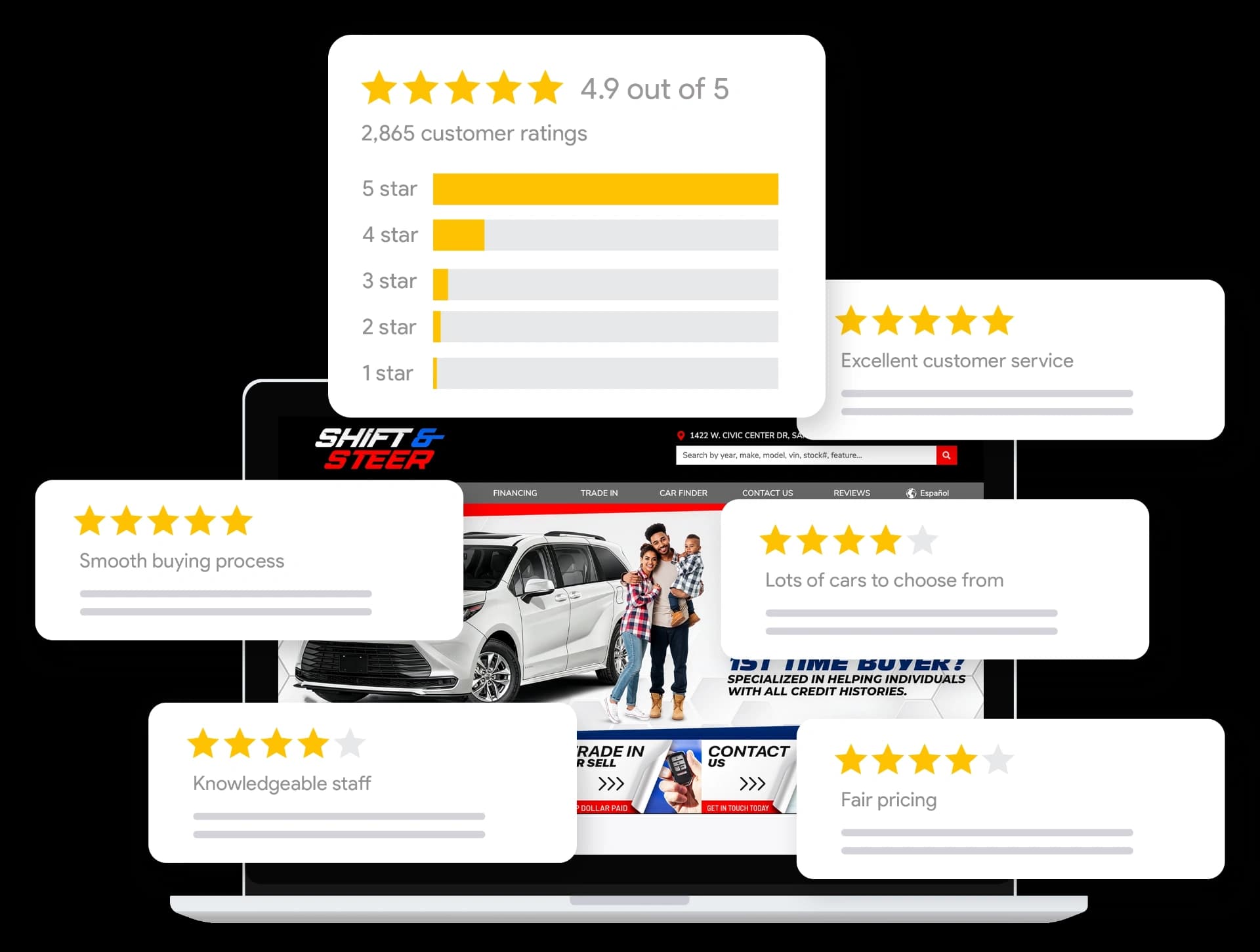
On the review side, set a target of one new Google review per car sold. Build the request into your delivery process. Send a templated text within 30 minutes of the customer driving off, when satisfaction is highest. Respond to every review, positive and negative, within 24 hours. Negative reviews handled professionally often build more trust than the positives. Diversify across Google, DealerRater, Yelp, BBB, Cars.com, and Facebook. AI search engines pull from all of these.
On your website, live review feeds from Google, Yelp, BBB, and DealerRater displayed on the homepage and inventory pages convert skeptics. Static testimonials are dead. Buyers have learned to ignore them. Live, dated, third-party-verified review feeds work because they cannot be fabricated. Instagram integration showing real buyer delivery photos amplifies the same effect. Trust badges, financing partner logos, and certifications belong above the fold, not buried in a footer.
Speed to Lead: The Operational Layer That Determines Marketing ROI
This is the section most marketing playbooks miss, which is why most marketing playbooks fail in practice. You can do everything else right and lose the deal because nobody answered the lead at 9pm on a Saturday. Marketing without a lead handling system is an expense, not an investment.
The numbers are stark. Harvard Business Review research shows that responding within 5 minutes makes a dealer 21 times more likely to qualify the lead than responding at 30 minutes. Demand Local data shows phone leads convert to appointments at 75%, internet leads at 40%, and 78% of car buyers go with the dealership that responds first. According to research cited by Demand Local, AI-powered CRM users see a 42% boost in conversion rate from online lead to test drive, and automation reduces lead response time to under 90 seconds. Yet 19% of dealers still take more than an hour to respond, and 74% of responses do not include a price quote according to the DAS Technology 2025 Lead Response Study. This is the gap where independent dealers can systematically out-execute larger competitors.
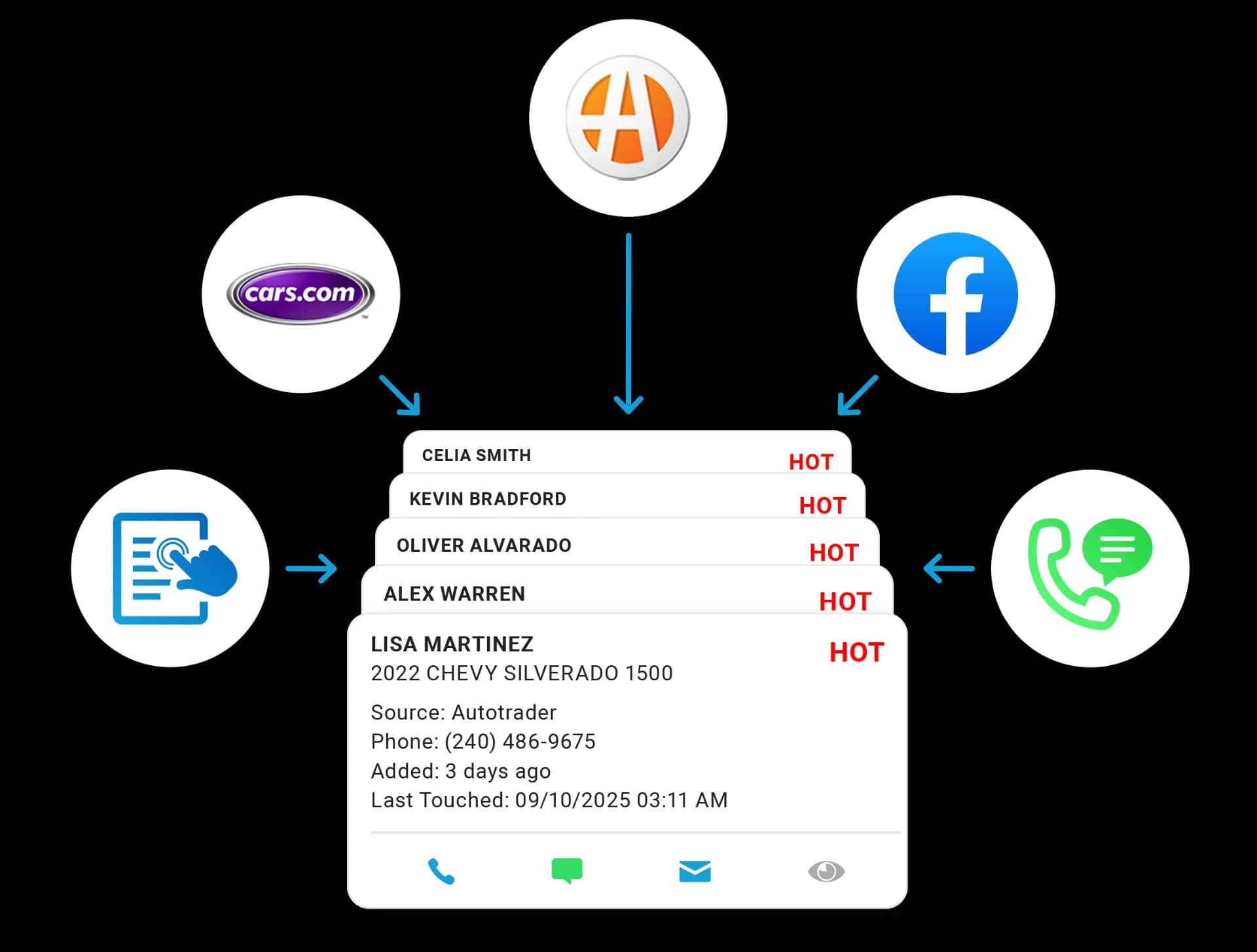
In 2026, the only practical way to hit sub-5-minute response times around the clock is AI-assisted lead engagement. A salesperson cannot respond at 11pm on a Sunday. An AI assistant can. Get My Auto's AI for auto dealers (Ava) responds to leads from any source (CarGurus, AutoTrader, Facebook, your website) in under 5 seconds, qualifies the lead through natural conversation, and books appointments without human intervention. The platform reports 70% faster follow-up and 32% more conversions on average. Ava also handles website chat 24/7, revives neglected leads, and operates in English and Spanish, which matters in many independent dealer markets.
The strategic point is not the specific tool. It is that without an AI layer between your marketing and your sales team, you are paying for clicks that die in the inbox. Whatever you spend on SEO, paid media, and social means little if the lead has chosen another dealer by the time you respond on Monday morning. Because no human team can answer every lead in seconds around the clock, many independents now close this speed-to-lead gap with an AI BDC that handles lead response instantly and follows up relentlessly until a rep takes over.
Retention and Repeat Business: The Margin Hidden in Your CRM
Most independent dealers think of marketing as customer acquisition. The dealers with the strongest unit economics treat retention as a parallel marketing function. Used vehicles average a 4 to 6 year ownership cycle, but service, trade-in, and referral revenue accumulate continuously across that window. Your existing customer database is the single most undervalued asset on your balance sheet.
The retention plays that work in 2026:
- Equity mining campaigns. Quarterly outreach to existing buyers when their trade-in equity hits a position that supports a vehicle upgrade with similar or lower payments.
- Service marketing. If you have a service department, fixed ops drives lifetime value and reactivation. Email and SMS reminders for state inspections, oil changes, and maintenance milestones.
- Referral programs with real economics. A $200 to $500 referral incentive is profitable on a used car deal, and referrals close at materially higher rates than cold leads.
- Birthday, anniversary, and holiday touchpoints. Cheap to run, surprisingly effective at keeping you top of mind in a category buyers think about rarely.
- Lapsed-customer reactivation. Your CRM should automatically flag customers who have not engaged in 18+ months and route them to AI-driven re-engagement sequences.
All of this requires CRM and marketing automation that talk to each other. Disconnected tools produce disconnected campaigns. A unified platform where the website, CRM, AI, and marketing all share the same customer record is the only way retention marketing scales without consuming a salesperson's time.
Measurement: What to Track and What to Ignore
Marketing without measurement is gambling. The metrics that matter for an independent or used car dealer in 2026 are tighter than most agency reports suggest.
Top of Funnel
- Organic visibility: rankings for your top 30 to 50 local commercial keywords, share of voice in your local map pack, and AI citation tracking for branded and category queries.
- Paid media efficiency: cost per qualified lead by channel, not cost per click. CPC is vanity. CPL is reality.
- Direct traffic and branded search volume month over month. This is the truest signal of brand strength.
Middle of Funnel
- Lead volume by source with deduplication across phone, form, chat, and walk-in.
- Speed to first response, by source and by hour of day. If your evenings are slow, you have an AI problem, not a sales problem.
- Appointment set rate and appointment show rate by lead source.
Bottom of Funnel
- Lead-to-sale conversion rate by source. Industry average is 2 to 5%. Top performers hit 8 to 15%.
- Cost per sale by channel. The true measure of marketing ROI.
- Gross profit per unit attributable to marketing-sourced sales.
What to Ignore
Stop reporting on impressions, raw website sessions, social followers, and email open rates as primary KPIs. They tell you nothing about whether you sold a car. They are diagnostic at best. The dashboards that matter answer one question: how many vehicles did each marketing dollar produce, and at what gross profit?
The Operational Stack: Why Connected Beats Best-of-Breed
There is a fashionable view that dealers should buy best-of-breed tools for each function and stitch them together. For large enterprise dealer groups with full IT teams, that can work. For independent and used car dealers operating with lean teams, it usually fails. Disconnected tools create data silos, attribution gaps, and manual handoffs that kill speed-to-lead and break the customer experience.
The strategic argument for a connected platform is operational. When your website, CRM, DMS, AI, and marketing tools share one data model, three things become possible. First, every lead is automatically routed and worked. No more leads dying in someone's inbox. Second, attribution is real. You can see which channel produced the sale, not just the click. Third, AI can actually function. Ava can only respond intelligently if it has access to live inventory, customer history, and pricing in one place.
The Get My Auto stack is built on this principle. The AI website platform feeds leads into the CRM in real time. The Vehicle Marketing System syndicates inventory across Craigslist, Facebook, Instagram, and the major listing sites from a single dashboard. Ava AI responds to every inbound contact across every channel within seconds, books appointments, and logs every conversation back into the CRM. For an independent dealer, that integration is what makes a modern marketing strategy actually executable on a small team.
A Practical 90-Day Implementation Plan
Days 1 to 30: Foundation
Strategy without a sequence is a wishlist. Here is the 90-day rollout I would run for an independent or used car dealer starting from a typical baseline.
- Audit and rebuild the dealer website on a fast, AI-ready, schema-rich platform with inventory feed integration
- Fully optimize the Google Business Profile. Categories, photos, vehicle inventory feed, weekly Google Posts, and a review acquisition workflow.
- Stand up CRM with automated lead routing and an AI-driven first response (sub-5-minute target, 24/7).
- Audit citations across the top 20 directories and fix every NAP inconsistency.
- Establish baseline measurement: lead volume by source, response time by source, lead-to-sale conversion.
Days 31 to 60: Channel Build
- Launch Google Search and Performance Max campaigns built around the inventory feed.
- Launch Meta inventory ads with retargeting and lookalike audiences from the buyer database.
- Activate automated Craigslist posting with smart-post technology.
- Begin weekly blog content focused on local market questions, model comparisons, and financing topics. FAQ schema on every post.
- Begin short-form vertical video at 2 to 3 posts per week. Walkarounds, deliveries, just-arrived inventory.
Days 61 to 90: Optimize and Expand
- Build city and service-area landing pages for every meaningful market within your trade radius.
- Launch retention campaigns: equity mining, service reminders, referral program, lapsed customer reactivation.
- Optimize VDPs at the template level. AI-generated descriptions, full schema, embedded reviews, conversion-optimized CTAs.
- Implement AEO/GEO content layer: comparison pages, direct-answer blocks, FAQ schema across all informational pages.
- Move to weekly KPI review on lead volume, speed to lead, appointment set rate, and cost per sale by channel.
This is not a one-quarter project. It is a one-quarter foundation. The dealers who treat marketing as an ongoing operational discipline rather than a quarterly campaign push compound results month over month. The ones who set it up, walk away, and check back in six months are the ones who say marketing does not work for independent dealers.
Frequently Asked Questions
The Strategic Takeaway
The dealers who win in 2026 are not necessarily the ones with the biggest budgets or the largest inventories. They are the ones who show up where modern buyers look, respond before competitors do, build trust through visible reputation, and operate on a stack where the website, marketing, AI, and CRM are not fighting each other. That is a higher bar than it was three years ago, and it is a much higher bar than what most independent dealers are operating at today. That gap is the opportunity.
If you are running an independent or used car dealership and the strategy in this post feels like more than your current systems can deliver, the platform layer is where to start. Get My Auto's AI-powered websites, Vehicle Marketing System, and Ava AI assistant are built for exactly this set of problems and exactly this kind of dealer. The strategy is the same either way. The execution is what separates the dealers winning the 2026 market from the ones still wondering why last year's playbook stopped working.
Explore Get My Auto's digital marketing for dealershipsShare this article
Help others discover this content