Table of Contents▾
Short answer: the best CRM for a car dealership is one built for the way dealers actually sell. It pulls in every lead automatically, follows up by text and call within seconds, and connects to your inventory and DMS, instead of forcing your team to retype everything into software meant for a different industry.
Picking a CRM is one of those decisions that quietly shapes how many cars you sell. Get it right and every lead gets worked, every follow-up happens, and your salespeople spend their time selling instead of chasing. Get it wrong and you are paying for software nobody opens while leads sit in an inbox until the customer buys down the street.
The trouble is that most CRM round-ups were written for real estate agents or B2B sales teams, not for a used car lot that gets leads from Autotrader, Cars.com, Facebook, and a dozen other places at all hours. This guide is written for dealers. It covers what actually separates a great dealership CRM from a generic one, the features worth paying for, and how to match a CRM to the way your store runs.
What makes a dealership CRM different
A general CRM is a database with a sales pipeline bolted on. A dealership CRM has to understand the realities of a car store. Your leads do not arrive one at a time from a single web form. They flood in from marketplaces, your own website, phone calls, walk-ins, and text messages, often outside business hours. The same shopper might fill out three forms on three cars in one night. And the moment a lead comes in, the clock starts, because the dealer who replies first usually wins the deal.
On top of that, a car deal touches systems a generic CRM has never heard of. You need the lead connected to your inventory, your desking and financing, and your DMS, so the customer record follows the deal from first click to delivery. A CRM that cannot do those things will always feel like extra work.
What to look for in the best car dealership CRM
Whatever you are comparing, judge each CRM against the things that actually move metal. Here is the checklist we would use.
- 1Automatic lead capture from every source. Autotrader, Cars.com, Facebook, your website, and phone calls should flow in on their own, with no manual data entry and no lead falling through the cracks.
- 2Instant, automated follow-up. The best CRMs respond to a new lead in seconds, day or night, with a real text or email, then keep following up on a schedule until the customer replies or buys.
- 3Texting and calling built in. Customers answer texts far more than calls or emails. A dealer CRM should send and log texts and calls inside the same system, so every conversation lives on the customer record.
- 4AI that works the hours your team cannot. The strongest platforms now answer leads, qualify them, and book appointments around the clock, then hand a warm, ready customer to your salesperson.
- 5Inventory and DMS integration. The CRM should know what is on your lot and pass deals cleanly into desking, financing, and your DMS, so nobody retypes a thing.
- 6Reporting and accountability. You should see, at a glance, which leads each rep is working, who is following up, and where deals stall, without chasing anyone for a status update.
- 7Mobile access. Your team sells on the lot, not at a desk. The CRM has to work just as well on a phone.
- 8Real onboarding and support. Dealership turnover is high, so you want a partner who trains your people and answers the phone, not just a login and a help article.
One more thing worth saying out loud: look for honest, dealer-friendly pricing. If a vendor will not give you a straight number, that tells you something.

Generic CRM vs. dealership CRM: a quick comparison
Here is how a general-purpose CRM stacks up against a CRM built for car dealers on the points that matter most.
| Capability | Generic CRM | Dealership CRM |
|---|---|---|
| Lead capture from Autotrader, Cars.com, Facebook | Manual or custom setup | Automatic, built in |
| Instant 24/7 follow-up | Add-on or DIY automation | Standard, often AI-driven |
| Texting and calling | Usually a paid add-on | Built in and logged |
| Inventory and DMS integration | Rare | Native |
| Built for the car-sales process | No | Yes |
| Onboarding for a dealership team | Generic | Dealer-specific |
What are the best CRM options for car dealerships?
Broadly, dealers choose from three kinds of CRM.
All-in-one dealer platforms are built specifically for car dealerships and bundle the CRM with inventory, marketing, and often a DMS. Because everything is connected, there is far less manual work, and the CRM understands the car-sales process out of the box. Get My Auto falls in this category: it captures every lead, follows up automatically by text and call, includes an AI assistant that works leads 24/7, and is connected to your DMS and inventory.
Generic CRMs like Salesforce or HubSpot are powerful and flexible, but they are built for general sales teams. You can make them work for a dealership, but it usually takes custom configuration, paid add-ons for texting, and integration work to connect your leads and inventory. For most independent and used-car dealers, that is more cost and complexity than the job requires.
DMS-bundled CRMs come attached to a dealer management system. They integrate well with that DMS, but the CRM itself is often an afterthought, with weaker follow-up and communication tools.
For most independent and used-car dealers, a purpose-built dealer platform wins on the thing that matters: it gets every lead worked without adding work.
Here is how the three kinds compare on the things that decide whether leads actually get worked:
| All-in-one dealer platform | Generic CRM + add-ons | DMS-bundled CRM | |
|---|---|---|---|
| Built for | Car dealerships specifically | General sales teams | The DMS it ships with |
| Car-sales workflow | Out of the box | Custom configuration | Partial, back-office first |
| Texting and calling | Built in, logged on the lead | Paid add-ons | Varies, often thin |
| AI follow-up | Included on modern platforms | Separate tools to integrate | Rare |
| Inventory and DMS connection | Native | Integration project | Native to its own DMS only |
| Typical setup | Days, dealer templates | Weeks, consultant common | Comes with the DMS contract |
| Best fit | Independent and used-car dealers | Stores with in-house ops staff | Stores that chose the DMS first |
What dealer CRM pricing actually looks like in 2026
We checked 11 dealer software vendors on July 28, 2026. Seven would not show a price without booking a demo (AutoRaptor, ProMax, VinSolutions, DealerSocket, CDK Elead, DriveCentric, and Dealertrack). The vendors who do publish pricing are the independent-dealer tools, and their advertised numbers deserve a careful read, because the sticker and the configured price are different things.
Two honest notes before the table. First, if you run a small lot and a basic lead inbox covers your needs, the lower-priced published tools are legitimate choices at that scale. Second, we sell the platform in the right-hand column, so check every cell against the sources: each number below comes from the vendor's own published pricing page as of July 28, 2026.
| DealerCenter CRM Plus | DealerCenter CRM Pro | Selly (AutoManager) | Get My Auto (CRM + Ava) | |
|---|---|---|---|---|
| Advertised price | $99/mo | $199/mo | $140/mo starting | $695/mo flat |
| Texts included | 2,000/mo | 4,000/mo | Unlimited (advertised) | Conversational texting included; 5,000 promotional blast texts/mo |
| Built-in calling | Not at this tier (click-to-call starts in Pro) | Included, with recording | Included | Included, with recording |
| AI follow-up | Add-on, +$99/mo | Add-on, +$99/mo | Not advertised | Included. The AI BDC is the product; the CRM is the core it runs on |
| Built for | Independent lots, a-la-carte modules | Independent and BHPH lots | Medium-to-large and multi-store independents (40+ cars/mo) | |
This table compares the CRM and AI layer only. Deal-desk costs like contract printing and credit pulls sit on the DMS side of every vendor's stack (and credit bureaus charge for pulls no matter whose software you run), so they are excluded here on all sides.
Sources: dealercenter.com/pricing, automanager.com/pricing, and our own trial page, all as observed July 28, 2026. Vendor pricing changes; check the pages directly.
The math that matters is per car, not per month. At the 40-cars-a-month scale this platform is built for, $695 is about $17 per car sold. One after-hours lead that gets worked instead of lost pays for the month. That is the argument for an AI BDC over a CRM with an AI add-on, and it is the reason we publish the bundle price on the trial page instead of hiding it behind a demo.
How to choose the right CRM for your dealership
Start with how your store actually runs. If leads slip through the cracks after hours, prioritize automated and AI follow-up (our AI BDC vs. human BDC comparison covers the cost math). If you are tired of paying for separate texting and phone tools, look for a CRM with communication built in. If you run buy-here-pay-here or want your CRM, inventory, and accounting in one place, an all-in-one dealer platform with a connected DMS will save you the most time. And if you run a used or independent lot, we keep a dedicated guide to the best CRM for used car dealers.
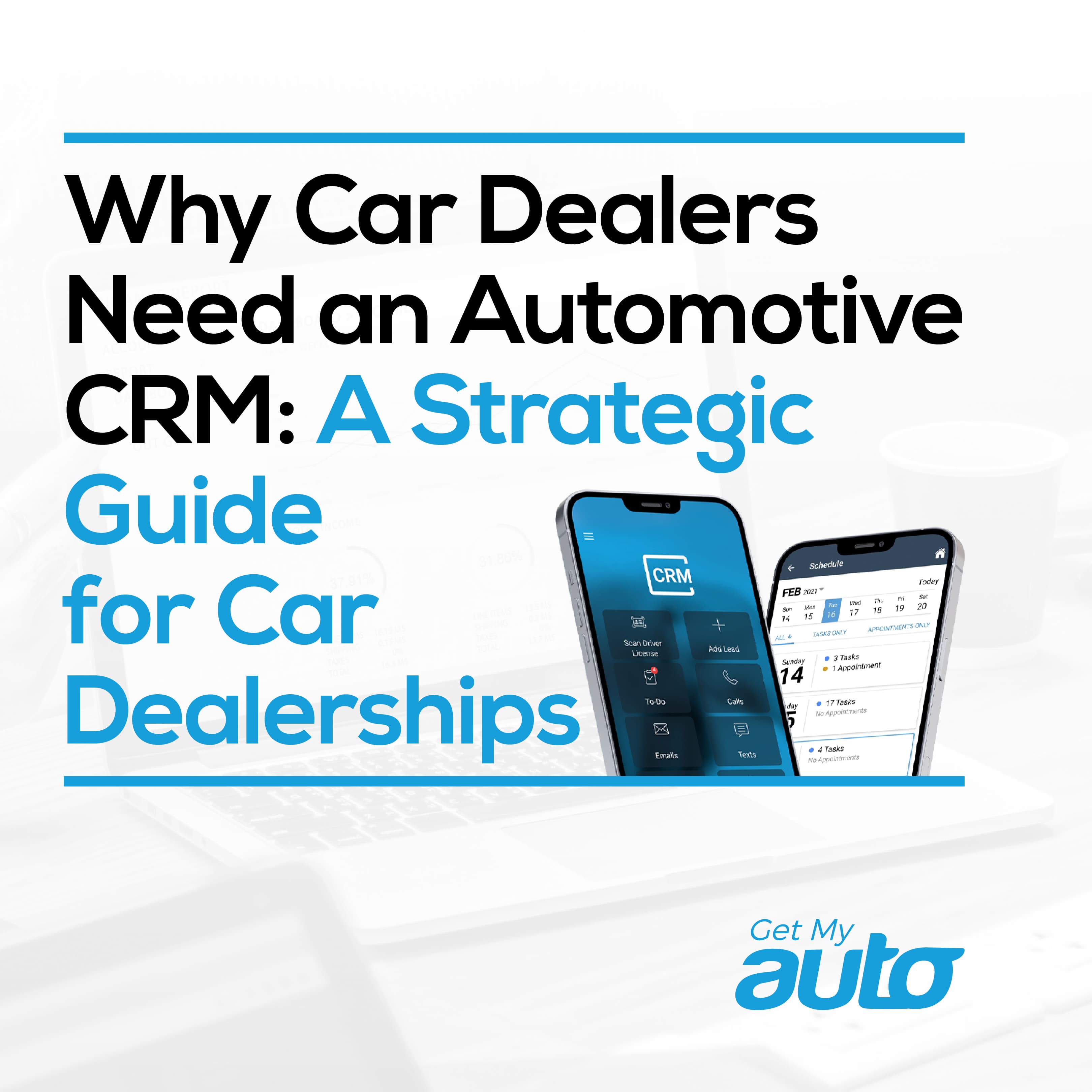
Whatever you pick, insist on a short trial or live demo with your own leads before you commit. You will learn more in twenty minutes of seeing it work on your store than in any feature list. If you want the longer version of why a dealer-specific CRM matters, our strategic guide to automotive CRM and our breakdown of the seven must-have CRM features go deeper.
Frequently asked questions
A CRM will not sell cars for you. But the right one makes sure every lead gets a fast, human response and a follow-up that does not depend on anyone remembering to do it. For most car dealerships, that is the difference between a good month and a great one. If you want to see what a dealer-built CRM looks like on your own leads, take a look at Get My Auto. If leads slip through the cracks after hours, it is worth understanding what an AI BDC actually does before you shortlist CRMs, since the best platforms pair that instant, around-the-clock response with relentless, automated follow-up.
Topics
Share this article
Help others discover this content