Table of Contents▾
The Real Problem on Independent Dealer Lots Right Now
Walk into almost any independent or used-car dealership in the country and you will see the same scene. Leads are coming in from a website, Facebook, Autotrader, Cars.com, phone calls, walk-ins, and texts. A salesperson has three sticky notes on a monitor, two missed calls on a personal cell phone, and a customer waiting on a test drive. The general manager is asking who followed up with the buyer from Saturday. Nobody is sure. The lead is already at a competitor down the road.
This is the gap that a modern auto dealer CRM is supposed to close. Not a contact list. Not a glorified spreadsheet with a sales tab. A real car dealer CRM is the operating system that captures every lead from every source, tracks every conversation, automates every follow-up, and gives ownership and management visibility into what is actually happening between the showroom door and the funded deal.
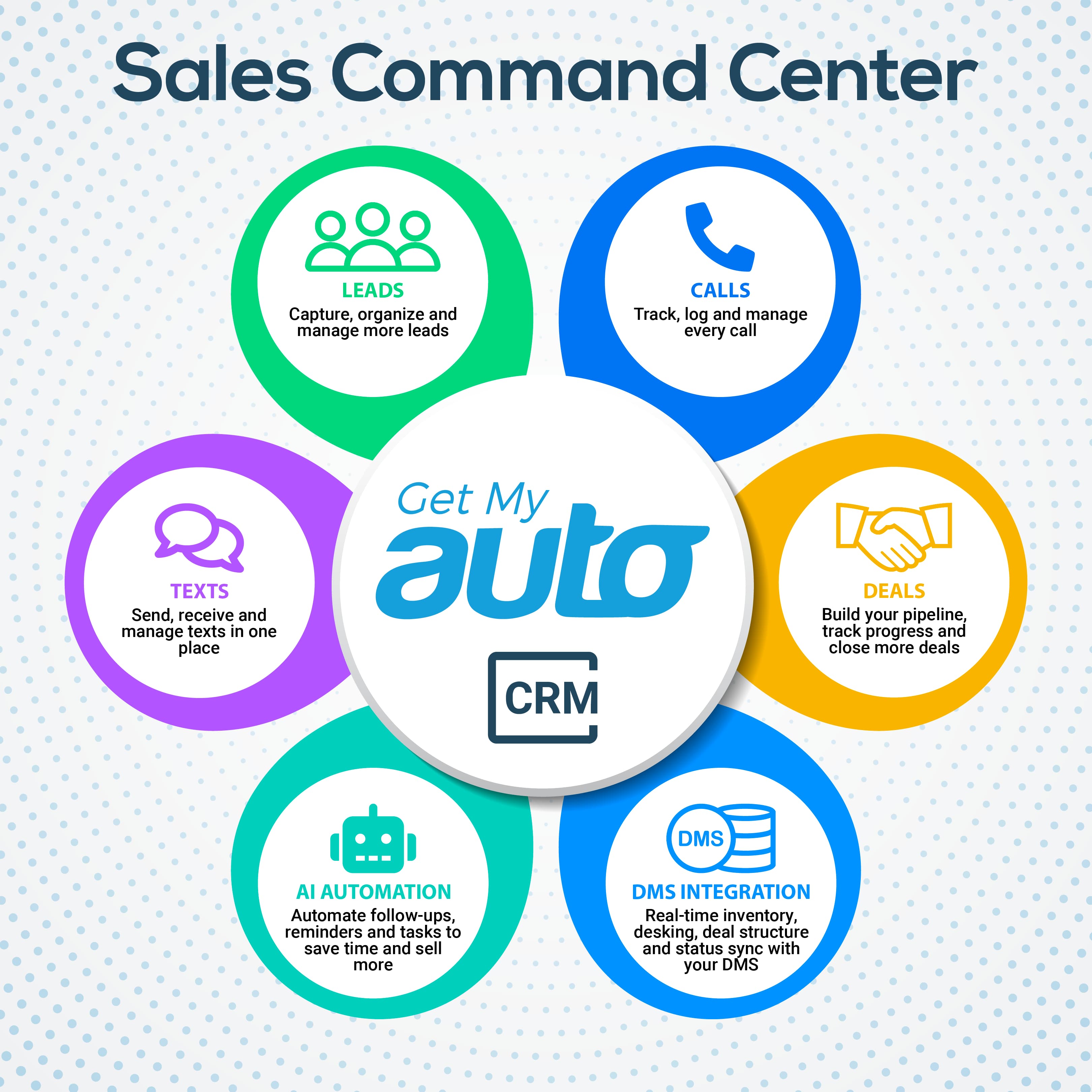
Get My Auto positions its CRM exactly this way. The product page calls it a "Sales Command Center" that combines leads, calls, texts, and deals in one platform, with AI automation and DMS integration sitting underneath. For independent and used dealers running lean teams, bundling matters more than any single feature in isolation. This article unpacks why.
What an Auto Dealer CRM Actually Is
Before evaluating any specific dealer CRM, it helps to define the category in operational terms rather than marketing terms.
An auto dealer CRM is the central system of record for every prospect and customer who touches your dealership. It captures inbound leads from websites, third-party listing sites, paid advertising, walk-ins, and phone calls. It tracks the full lifecycle of each opportunity through a defined sales process. It records every interaction the team has with that prospect, whether by phone, text, or email. It assigns and enforces follow-up tasks. It produces the reporting that tells ownership which marketing dollars work, which salespeople sell, and which deals are about to die.
A dealership without a CRM is not running a sales process. It is running a hope strategy. Get My Auto frames the without-CRM reality plainly on its product page: leads scattered across email, voicemail, and sticky notes, no clarity on who is supposed to follow up with whom, no manager visibility, inconsistent training, and 40 to 50 percent of leads that never get a follow-up call at all.
That last number is the one that drives ROI math. If half your leads vanish before anyone speaks to them, your cost per sale is double what it should be, and every dollar of marketing spend is working at half efficiency. The case for a car dealer CRM is not really a software case. It is a math case.
Where Get My Auto Fits in the Dealer CRM Landscape
The CRM space for automotive retail has historically split into two camps. On one side are the enterprise platforms built primarily for franchise operations, with deep OEM integrations and pricing structures that match. On the other side are generic small-business CRMs that were never designed for the way a car deal actually flows from lead to test drive to F&I to delivery.
Get My Auto sits in a third lane that is increasingly relevant for independent and used dealers. It is built specifically for automotive retail, which means the data model, the workflows, and the integrations assume you are selling vehicles rather than SaaS subscriptions or insurance policies. At the same time, it is positioned for independent and franchise dealerships of the size that cannot justify a six-figure enterprise rollout but have outgrown a basic contact manager.
The platform is part of a broader Get My Auto product suite that includes a DMS, websites, VIN tools, AI services, and marketing products. The CRM is one component, but it is designed to plug into the rest, which matters for dealers who want one vendor for inventory, website, and customer data rather than five vendors with brittle integrations between them.
The Seven Modules That Make Up the Get My Auto CRM
Get My Auto organizes its CRM around seven core modules. Each one addresses a specific failure point in the typical independent dealer sales process.
Lead Capture and Distribution
The first failure point on most lots is the lead pipe itself. Leads arrive from fifteen or more sources. Without automation, half of them require manual entry, and a meaningful share of those never make it into any system at all. Get My Auto auto-imports leads from hundreds of sources with no manual data entry. Every lead carries full attribution, so you know whether it came from your website, a paid Facebook campaign, Autotrader, a direct phone call, or a walk-in.
Distribution is where the politics of a sales floor usually break the system. Get My Auto supports round-robin, manual assignment, or first-come-first-served distribution, with custom rules based on lead source, vehicle interest, or rep specialization. The point is fair distribution and full traceability. The "I never got that lead" excuse goes away because the system shows exactly who was assigned what and when.
Visual Sales Pipeline
The second failure point is visibility. Most independent dealers cannot answer a simple question with confidence: which deals are likely to close this week, and which ones are about to die? The Get My Auto pipeline is built around the Road to a Sale, which is the shared mental model most automotive sales managers already use. Every prospect sits in a defined stage. Stalled deals are visible before they go cold. Forecasting becomes a function of the data rather than a guess on a Friday afternoon.
For used and independent operators, this is where inventory planning and sales planning start to talk to each other. If you can see what is realistically closing in the next 30 days, you can stock and price accordingly.
Activity Tracking and Accountability
The third failure point is the management layer. A sales manager who cannot see daily activity is managing vibes. Get My Auto logs every interaction automatically. Calls, texts, emails, and notes all attach to the customer record without a rep having to remember to type anything in. The real-time dashboard shows who is working which leads, who is producing, and who is coasting.
The accountability piece is not just about catching underperformers. It is also about being able to pick up exactly where any rep left off on any deal. When a salesperson is off, sick, or quits, the deal does not have to die with them.
Built-In Phone System with Call Recording
The fourth module is one of the most undervalued in independent dealer environments. Get My Auto includes a built-in phone system with single-click calling from any lead or contact record. Every call is automatically recorded, logged, and attached to the customer record. Duration and outcome are captured automatically.
The training implications are significant. New salespeople can listen to actual closes from the top performers on the floor. Managers can pinpoint exactly where deals fall apart by reviewing recorded conversations rather than reconstructing them after the fact. Disputes about what was said during a sale can be resolved with the actual recording. For independent dealers who often run with smaller teams and limited formal training programs, this turns the CRM into a coaching tool, not just a tracking tool.
Text Messaging Built Right In
The fifth module reflects how customers actually communicate in 2026. Email open rates hover around 20 percent. Text open rates sit near 98 percent. Get My Auto puts SMS directly inside the CRM. Reps send and receive texts from the platform on desktop or mobile. Every message logs to the customer record automatically. Appointment reminders and timed follow-ups can be scheduled and automated.
For independent dealers in particular, this matters because the buyer pool often includes a meaningful share of customers who simply will not answer a phone number they do not recognize but will respond to a text. Meeting customers where they actually communicate is no longer optional, and bolting on a third-party texting tool always creates the same problem: conversations that never make it back into the CRM.
Task and Appointment Management
The sixth module enforces the discipline that human memory cannot. Tasks generate automatically based on lead stage and deal progress. Calendar integration handles reminders. Overdue tasks escalate. The full appointment view across the team is visible in one place.
The underlying principle is that consistent customer experience cannot depend on which rep happens to pick up the deal. The CRM enforces the cadence regardless of who is on the floor that day.
Contact Management
The seventh module is the long-term equity play. Every customer becomes a complete record with purchase history, communication history, preferences, and trade-in information. This is where used and independent dealers build something that is genuinely defensible: a database of past customers who can be retargeted when they are due for their next vehicle, when an in-equity opportunity opens up, or when inventory matches a known preference.
Contact management is the module that turns a CRM from a sales tool into a customer retention asset. Done well, it produces a meaningful share of repeat and referral business that does not cost anything in advertising spend.
The AI Layer That Changes the Math
The seven core modules describe the system of record. The AI layer describes what happens when nobody is watching.
A lead arrives at 11 PM on a Saturday. In the old model, that lead waits until Monday morning. By Monday morning, the customer has heard back from two other dealers and bought from one of them. Get My Auto's AI responds to new leads within seconds, any time of day. It writes personalized follow-up messages that read as human. It schedules calls and texts at optimal times. It continues conversations when the dealership is closed.
The product page describes a representative scenario. A lead comes in Saturday at 11 PM. The AI sends a personalized text within 60 seconds. The customer responds. The AI continues the conversation, gathers qualifying information, and books an appointment for Monday. The salesperson walks into Monday with a warmed-up, qualified buyer ready to talk numbers.
This is the operational difference that closes the gap between what an independent dealer can do with five salespeople and what a much larger operation does with twenty. The marketing automation layer extends the same logic into nurture sequences, service reminders, and trade-up offers. The result, in Get My Auto's framing, is that a ten-person team can handle a twenty-person workload.
For independent operators, this is the most important shift in the dealer CRM category in the last five years. AI is not a feature that gets bolted onto a CRM. It is becoming the reason the CRM exists. Responding in seconds and qualifying buyers even when the showroom is closed is exactly what an AI BDC is, and understanding how it compares to a chatbot or a human team is worth a closer look.
Text Blast Campaigns and the Inventory Movement Problem
Every used dealer has the same recurring problem. Some inventory moves quickly. Some sits. The cost of carrying a unit that sits for sixty days is the difference between a profitable month and a flat one. Email blasts are too slow and too easy to ignore. Phone outreach does not scale.
Get My Auto's text blast feature targets this problem directly. A new F-150 lands on the lot. The dealer sends a text blast to every customer who looked at trucks in the last 30 days. The platform reports a representative result of 50 responses in the first hour, 12 weekend appointments, and the truck sold by Monday.
The targeting capability is what makes this useful rather than spammy. Lists can be segmented by vehicle type, price range, or shopping behavior. Pre-built templates handle the common scenarios. Real-time tracking shows who opened, clicked, and responded. For independent dealers managing inventory turn as a primary KPI, this is one of the highest-leverage features in the entire platform.
Integration: Why a Standalone CRM Is the Wrong Question
A common evaluation mistake is to compare dealer CRMs as standalone products. The right comparison is how the CRM behaves inside the rest of the dealership technology stack. Leads flow into the CRM, but the deal flows into the DMS. Inventory lives somewhere. The website pushes leads in. Desking tools sit in the middle of the sale.
Get My Auto's CRM is built to plug into the broader Get My Auto platform. It is connected to the DMS, the website, the inventory feed, and desking tools. There is also a mobile app for activity outside the showroom. The strategic implication for independent dealers is that the CRM is not a silo. The customer record, the inventory record, and the deal record can be the same record, which removes a meaningful share of the duplicate-entry and reconciliation work that breaks data quality in multi-vendor stacks.
For dealers who already operate inside another DMS, integration depth becomes the primary diligence question during evaluation. For dealers using the Get My Auto DMS, the integration question is mostly answered by default.
A Light-Touch Framework for Evaluating a Dealer CRM
A full evaluation framework is its own article, but a few questions separate serious dealer CRM platforms from contact managers wearing a CRM label.
First, does the platform automate lead capture from every source you use, or does someone on your team have to copy and paste? If lead entry is manual, the system will fail at the first failure point.
Second, are calls and texts native, recorded, and logged automatically? If communications live in a separate phone system or texting app, conversations will go missing and coaching becomes guesswork.
Third, is there an AI layer that responds to leads outside business hours and handles the repetitive work? Without this, after-hours leads continue to leak to faster competitors.
Fourth, does the CRM integrate with your DMS, website, and inventory in a way that does not require manual reconciliation? Integration depth determines whether the CRM saves time or creates more work.
Fifth, does management have real visibility into rep activity and pipeline status without having to ask anyone for an update? If reporting is a manual exercise, accountability will degrade over time.
Get My Auto answers all five of these questions inside one platform, which is the core argument the product page makes. The framework matters even if you choose a different platform. The questions remain the same.
What Independent and Used Dealers Should Actually Expect
Get My Auto cites a 95 percent or better follow-up rate, a 98 percent text open rate, 24/7 AI response, and a single unified platform. The product page also references a 20 to 30 percent increase in units sold with the same headcount, with most dealers seeing meaningful lift within 90 days of implementation.
These are vendor numbers and should be treated as such during diligence. The more useful framing for an independent dealer is the comparative one. If your current follow-up rate is below 60 percent, which is typical without a CRM, the lift from automating follow-up alone is significant. If your team is currently spending hours per day on data entry, reminder calls, and status updates, the lift from automating those tasks is significant. If your manager cannot tell you which reps are working which leads, the lift from real-time visibility is significant.
The ROI case for a dealer CRM does not depend on the headline numbers. It depends on which specific failure points exist on your lot today and how many of them the platform actually closes.
Questions About Get My Auto CRM
What does the Get My Auto CRM include? The CRM bundles seven core modules: lead capture and distribution, a visual sales pipeline, activity tracking, a built-in phone system with call recording, native text messaging, task and appointment management, and contact management. AI lead response and marketing automation sit on top of those modules, and the platform integrates with the broader Get My Auto DMS, website, and inventory tools.
How does the Get My Auto CRM capture leads? Leads auto-import from hundreds of sources, including dealer websites, third-party listing sites, social platforms, phone calls, and walk-ins. Each lead carries full attribution data so the source, vehicle of interest, and assignment history are visible on the record from the moment it lands.
Can I text and call leads from inside the Get My Auto CRM? Yes. The phone system and SMS are native to the platform. Calls are placed with a single click from any lead or contact record and are automatically recorded and logged. Texts send and receive directly inside the CRM, with every message attached to the customer record.
Does Get My Auto CRM work on mobile? Yes. The platform works on any computer or mobile phone with internet access, and there is a mobile app for activity outside the showroom.
How does the Get My Auto CRM connect to the rest of the platform? The CRM is built to integrate with the Get My Auto DMS, dealer website, inventory feed, and desking tools. Customer, inventory, and deal data flow through the connected system rather than living in separate silos.
How long does Get My Auto CRM onboarding take? Get My Auto offers white-glove onboarding with flexible plans and no long-term contracts. Specific implementation timelines vary by dealership size and existing systems, which is the kind of question best answered during a demo with the Get My Auto team.
Get My Auto: Best CRM for Independent and Used Auto Dealers
The case for an auto dealer CRM is not about software preference. It is about whether your sales process can survive the volume and velocity of the leads you already pay to generate. Without a real CRM, the math does not work. Marketing leaks out the back door. Reps work without visibility. Deals die in the gap between Friday afternoon and Monday morning.
Get My Auto's positioning is direct. The platform is built as a sales command center for independent and franchise dealerships, with the modules, AI layer, and integrations designed for the way a vehicle actually sells in 2026. For used and independent operators in particular, the combination of native communications, automated follow-up, and real management visibility addresses the failure points that quietly cost the most money on the average lot.
The rest of the evaluation is a demo conversation. Bring your real lead volume, your real source mix, and your real team size. Ask the questions in the framework above. Whether or not Get My Auto is the right platform for your dealership, the questions are the right ones to ask of any car dealer CRM you consider. You can try the CRM and Ava free for 60 days.
Share this article
Help others discover this content