
Table of Contents▾
Short answer: AI literacy for an auto dealer means four things: knowing what each AI tool in the store does, where its data comes from, what it gets wrong, and what to measure. It is a job skill for every role, not an IT project, and it can be learned in weeks.
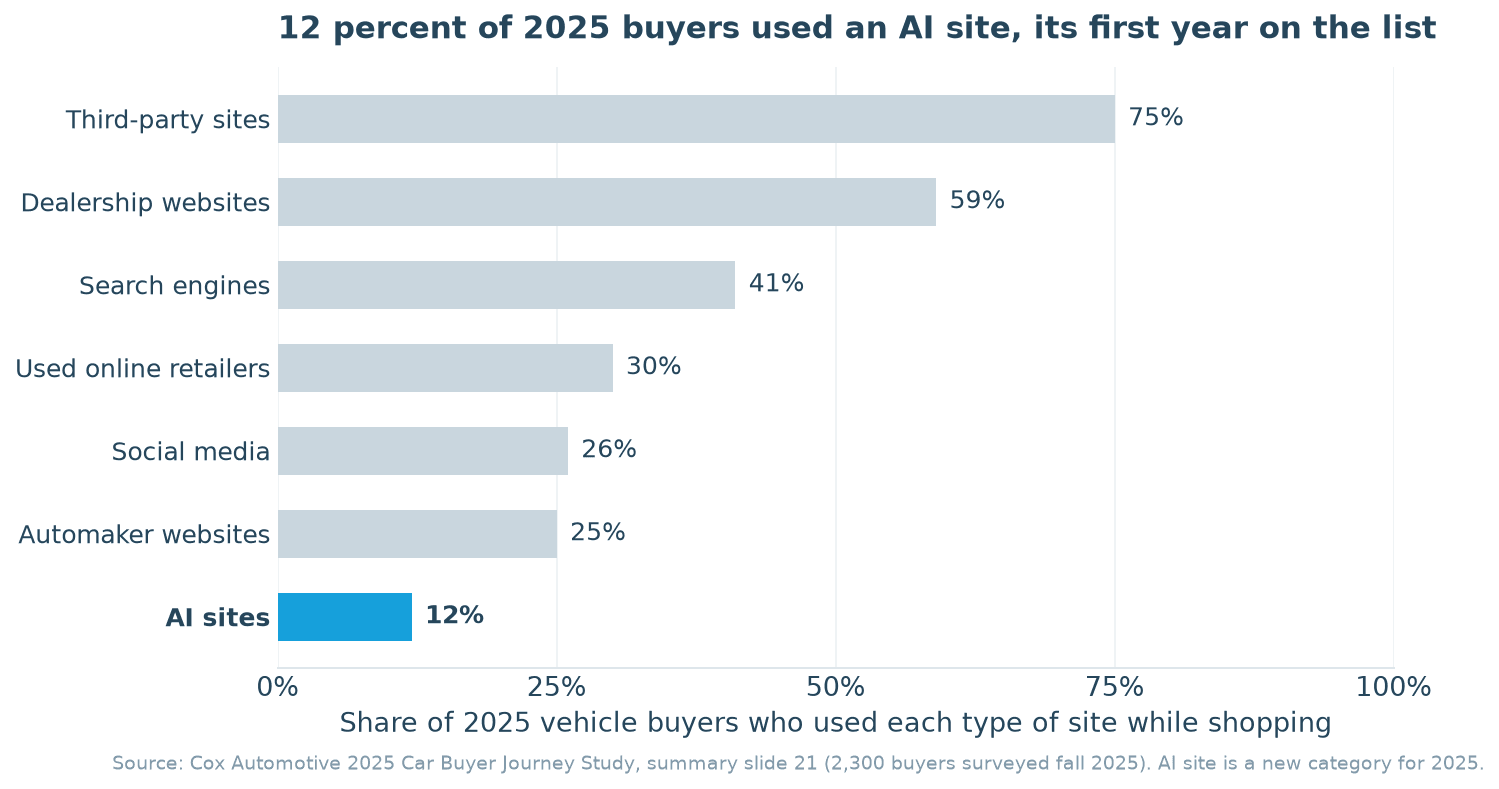
Car buyers already use AI in the purchase, so the store has to understand it too. Cox Automotive's 2025 Car Buyer Journey Study, a survey of 2,300 buyers fielded in fall 2025, found that 19 percent of all buyers and 25 percent of new-vehicle buyers used AI websites or AI-generated overviews while shopping. Twelve percent used an AI site as one of the places they shopped, the first year that category appeared on the list, and 84 percent of mostly digital buyers who engaged AI assistants were highly satisfied.
The habit is broad. Pew Research Center reported in June 2026 that about half of US adults now use AI chatbots, up from a third in 2024, and about four in ten use them to search for information.
Dealers feel the gap. In Cox Automotive's AI Readiness in Auto Retail study of 537 franchise dealership leaders, published October 2025, 81 percent said AI is here to stay, 60 percent were "beginning to test the waters," and nearly 15 percent were "embedding AI tools into workflows and decision-making." The same dealers named the problem: accuracy and errors concern 74 percent of them, and 66 percent want more education and training. That study covered franchise stores. Independent dealers run the same tools with smaller teams and less cover.
The same kind of software is now inside the store. Assistants answer leads at night, pricing tools recommend numbers from market data, ad platforms write creative from the inventory feed, and document tools check stipulations. None of that needs a programmer. It needs people who know what each tool is doing in their name.
That is the gap. A BDC rep who has never read the assistant's transcripts cannot catch a wrong promise. A used car manager who does not know where a pricing tool pulls its comps will trust a number from the wrong market. Literacy closes that gap, role by role, and it is the cheapest part of any AI rollout.
AI Literacy for Auto Dealers, Explained
AI literacy, for a dealership, is the working knowledge a person needs to use an AI tool well in their own job: what it does, where its data comes from, what it gets wrong, and how to judge its output. It is not coding, and it is not a bag of prompt tricks. A general manager, a BDC rep and a used car manager each need a different slice of it.
| What to understand | Why it matters | Example on the lot |
|---|---|---|
| What the tool does, and does not do | Sets the right expectations before anyone relies on it | An assistant that answers leads by text and email does not answer the phone. The phone still rings to a person |
| Where its data comes from | The output is only as good as the feed behind it | A pricing recommendation built on comps from 200 miles away is not your market |
| What it gets wrong | Every model can state a wrong fact with full confidence | A chatbot quoting a monthly payment it was never given |
| What to measure | You manage what you can see | Response time, appointment rate and gross per unit, not messages sent |
The four questions are the same in every department. The answers are not, which is why literacy is taught by role: the BDC rep needs to know what the assistant may promise and when it hands off, the used car manager needs to know how a recommendation is built, the F&I manager needs to know that a product suggestion is not a compliance check, and the general manager needs to know what each tool should move on the monthly statement.
Where AI Already Works in a Dealership
AI is already in five departments of a typical store, and each one needs a different piece of literacy.
| Department | What AI does today | What the team has to understand | What to measure |
|---|---|---|---|
| Marketing | Writes ad creative from the inventory feed, builds dynamic inventory ads, triggers offers on equity and lease-end dates, and shapes how AI answers describe the store | Which inventory and price data the tools publish. AI answers cite pages, so the site must show the price a shopper can actually pay | Leads and VDP views by source, cost per lead, which inventory pages AI answers cite |
| Sales and BDC | Answers inbound leads in seconds by text and email at any hour, follows up on a schedule, scores leads, books appointments | What the assistant may promise on price, availability and financing, when it hands off to a person, and that every transcript lands in the CRM | Response time, contact rate, appointments set and shown, units sold |
| F&I | Suggests products that fit the buyer and vehicle, checks stipulations and documents, flags missing disclosures | A suggestion is not a decision. Required disclosures and lender rules still govern, and a person signs off | Time in F&I, funding delays, chargebacks, customer satisfaction scores |
| Inventory and used cars | Recommends prices from live market data, targets acquisitions by make, model and trim, flags service-lane cars worth buying | Where the comps come from and how old they are. The tool recommends; the manager prices | Days to turn, front gross, aged units, appraisal-to-purchase rate |
| Service | Schedules and reminds, drafts status updates, spots service customers who own cars the used lot needs | What the message says, who owns the reply, and what happens when the customer answers | Appointments kept, repair order value, trade leads from the lane |
Marketing is where buyer behavior shows up first. AI sites joined the list of places buyers shop in 2025, at 12 percent, behind social media at 26 percent and search engines at 41 percent.
The answers themselves are now mainstream search. Google said in May 2026 that AI Overviews has over 2.5 billion monthly active users and AI Mode passed 1 billion within a year of launch. If a vehicle page shows a price the buyer cannot actually pay, that is the price the answer will repeat.
Two Get My Auto guides cover the first two rows in depth: AI search visibility for auto dealers and what an AI BDC is and what it costs.
The Literacy Ladder
Most stores need every employee at level two, one person per department at level three, and the general manager at level four.
| Level | What it looks like on the lot | How you know you are there |
|---|---|---|
| 1. Aware | Knows which AI tools the store runs and what each one is for | Every employee can name the tools in their department and say what they do |
| 2. User | Uses the tool daily, reads its output critically, knows when it hands off | Reps read the assistant's conversations before they call. Managers check a pricing recommendation against the comps |
| 3. Operator | Configures and tunes it: scripts, guardrails, what it may promise, when it escalates | One named owner per tool, and a written list of what the assistant may and may not say |
| 4. Owner | Ties each tool to the numbers and decides what to add, fix or retire | A monthly review of response time, appointment rate and pricing accuracy, with vendor questions answered in writing |
The jump that matters is from level one to level two. A team that reads what the tools produce catches most problems in the first week. A team that only knows the tools exist finds out from a customer.
Risks and Guardrails
The failure modes are predictable, and each one has a cheap guardrail.
| Risk | What goes wrong | The guardrail |
|---|---|---|
| Confident wrong answers | An assistant quotes a payment, a rate or an availability it was never given | It answers only from the system of record: the CRM, the inventory feed, the desking tool. Anything else goes to a person |
| Advertised price compliance | The first reply, an ad or a listing quotes a price a buyer cannot actually pay | The AI reply must match the advertised price, document fee included, on every channel |
| Customer data | Transcripts, credit details or trade-in data flow to a vendor with no stated retention or reuse limits | A written answer on what the vendor stores, for how long, and whether it trains on your data |
| Disclosure | A shopper believes a person is texting them | Say it is an assistant, and make the handoff to a human easy and fast |
| Human handoff | A hot buyer waits because the assistant kept the conversation going | A named trigger (price objection, trade-in, credit, "call me") that notifies a person within minutes |
| Drift | Nobody reads the transcripts, so the same error repeats for months | A weekly review of 20 conversations by the tool's owner |
The compliance row is not theoretical. In March 2026 the Federal Trade Commission sent letters to 97 auto groups "warning them that the prices they advertise must be the total price, including all mandatory fees, that consumers will be required to pay." In September 2026 FTC staff published pricing transparency FAQs that state "the FTC Act requires that the advertised price be the actual price any consumer can walk in and pay," and that the rule applies to "phone calls and text messages with a dealer's staff" as much as to websites. The FAQs are staff guidance and "not binding on the public or the Commission," but they describe how the agency reads the law, and an assistant texting prices on the store's behalf is covered by the same reading.
Two Get My Auto guides go deeper: AI governance best practices for auto dealers and the FTC price transparency FAQs for car dealers.
A 90-Day Plan That Needs No Specialist
Three months is enough to get a whole store to level two and every department to level three, with no new hire.
| Window | Do | Done when |
|---|---|---|
| Days 1 to 30 | List every AI tool in the store and name one owner per tool. Write the "may say, may not say" list for any assistant that talks to customers. Put the team through a fundamentals course | Every employee can name the tools in their department, each tool has an owner, and the list is in writing |
| Days 31 to 60 | Owners read 20 transcripts a week. Check 20 pricing recommendations against the comps the manager would pull. Record response time, appointment rate and days to turn before and after | The three most common errors are found and fixed, and the baseline numbers fit on one page |
| Days 61 to 90 | Tune the guardrails and handoffs. Add one new use where the numbers justify it. Retire anything nobody opens. Start a monthly review | The general manager reads a one-page review each month, and one tool has been retired or added on evidence |
The transcript review is the step most stores skip, and it is the one that pays. Twenty conversations a week is under an hour, and it is where a wrong promise, a stale price or a missed handoff shows up before a customer mentions it.
Eight Questions to Ask Any AI Vendor
A literate buyer asks these before the demo ends, and expects plain answers.
- 1What does it answer from, and what happens when the answer is not in that data? Good answer: it quotes only your CRM, inventory and desking data, and hands everything else to a person.
- 2Which channels does it work on today? Good answer: a specific list (text, email, web chat), and a straight answer on whether it takes phone calls.
- 3What can we forbid it from saying? Good answer: a list you control, with price, financing and availability promises on it by default.
- 4Where do the transcripts live, and who owns them? Good answer: in your CRM, and you do.
- 5How does it hand off, and how fast? Good answer: named triggers, a person notified within minutes, and a record of every handoff.
- 6Can we audit a conversation after the fact? Good answer: every message, timestamp and action is logged and searchable.
- 7What happens to our customer data? Good answer: a written retention period, and a written statement on whether it is used to train models for anyone else.
- 8What does it cost all in? Good answer: one number that includes messaging and integrations, with any usage fees spelled out, in writing.
Where to Start
Start with the people, not with another tool. Most of the errors in the risk table above are caught by someone who knows what to look for, and that person is already on the payroll.
Put the whole team through a fundamentals course first. Clarity Digital's AI Fundamentals for Auto Dealers is free, runs 75 minutes across seven lessons, and is built, in its own words, "for every seat in the dealership: salespeople, floor and sales managers, F&I managers, service advisors, BDC and marketing, and dealer principals." The lessons run by role: AI basics for the dealership; selling faster with AI, for salespeople; coaching and desking, for floor and sales managers; compliance first, for F&I managers; a lesson for service, BDC and marketing; strategy and governance, for owners and dealer principals; and a 30-day dealership AI action plan. A final quiz follows the lessons, the academy issues a verifiable certificate of completion to anyone who passes, and no credit card is required. Then run the 90-day plan with the tools the store already owns.
Where Get My Auto fits. Get My Auto builds the tools this guide keeps referring to: Ava, an AI BDC that answers every lead in under 5 seconds by text and email, in English and Spanish, and a CRM that keeps every conversation where a manager can read it. Both are available on a 60-day free trial, which is the easiest way to run the transcript review in the plan above on your own leads.
About the author. Clarity Digital, founded by Al Sefati, is an AI agency that designs, builds and deploys custom AI agents, agentic workflows and enterprise AI strategy, and runs a free AI Academy of more than 26 courses with certificates of completion. Clarity Digital is also Get My Auto's partner on its vehicle marketing system.
Frequently Asked Questions About AI Literacy for Auto Dealers
Sources
- Cox Automotive, Car Buyer Journey Study press release, January 13, 2026, and the 2025 study summary deck, slide 21.
- Cox Automotive, Automotive Dealers Are Ready for AI to Deliver Outcomes and Skip the Hype, October 28, 2025.
- Pew Research Center, Americans and AI, June 17, 2026.
- Google, I/O 2026 keynote post, May 19, 2026.
- Federal Trade Commission, Automobile Industry Pricing Transparency FAQs, September 2026; press release, September 15, 2026; letters to 97 auto groups, March 13, 2026.
- Clarity Digital: the AI Fundamentals for Auto Dealers course page (title, lesson names, length, audience and final quiz), the AI Academy page (free, no credit card, certificate of completion after the quiz), and the ClarityDigital.ai homepage, which supplied the company description in the author bio.
Topics
Share this article
Help others discover this content
About the Author
Clarity Digital, founded by Al Sefati, is an AI agency that designs, builds and deploys custom AI agents, agentic workflows and enterprise AI strategy, and runs a free AI Academy of more than 26 courses with certificates of completion. Clarity Digital is also Get My Auto's partner on its vehicle marketing system.
Continue Reading
View All
FTC Price Transparency FAQs: What Car Dealers Must Do (2026)

What Is an AI BDC for Car Dealerships?

AI Governance for Auto Dealers: A 2026 Compliance Guide